Hayreddin Barbarossa
Grand Admiral (Kaptan-ı Derya) • 1478 – July 4, 1546
"He who commands the seas commands the world."

Birth and Family
Born Hızır in 1478 on the Ottoman island of Lesbos (Midilli), Hayreddin Barbarossa came from a family that would reshape the Mediterranean world. His father, Yakup Ağa, was an Ottoman sipahi who had settled on Lesbos after migrating from Vardar Yenicesi. His mother, Katerina, was a woman of Greek Orthodox heritage.
He was one of four brothers: İshak, Oruç, Hızır (Barbarossa), and İlyas. The youngest brother İlyas was killed at a young age during a skirmish with the Knights of Rhodes.
Physical Appearance and Character
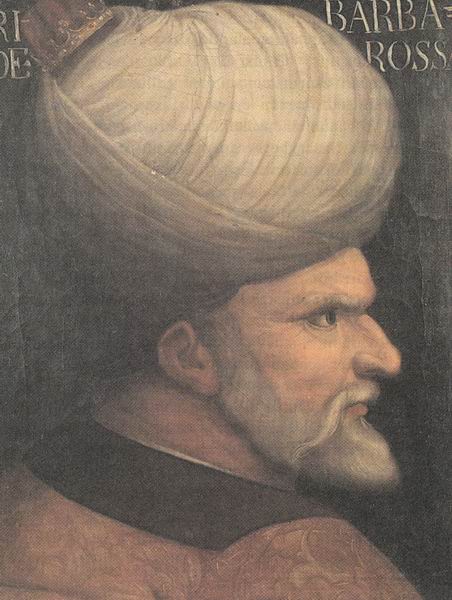
Contemporary sources describe Barbarossa as a powerfully built man with a tan complexion. His hair, beard, eyebrows, and eyelashes were thick and full — most notably his red-tinged beard, which drew immediate attention. The Italian nickname "Barbarossa" (from barba rossa, meaning "red beard") originated from this distinctive feature.
He was a man of many talents and a lover of music. He spoke Greek, Arabic, Spanish, Italian, and French fluently — command of the principal languages of the Mediterranean that proved invaluable in his diplomatic dealings.
Youth and Early Voyages
Barbarossa and his brothers initially engaged in commercial shipping, transporting goods between Lesbos, Thessaloniki, and Euboea. Their lives changed course when his elder brother Oruç Reis was captured by the Knights of Rhodes and spent three years chained to a galley oar.
After Oruç escaped and turned to corsairing, Hızır joined him at sea. Together they conducted a string of successful raids against Spanish and Italian shipping across the Mediterranean.
The Age of Oruç Reis and the Conquest of Algiers
Under the command of his elder brother Oruç Reis, Hızır mastered the art of naval warfare in the western Mediterranean. In 1516, Oruç seized Algiers from Spanish control and established his authority over the region.
In 1518, however, Oruç Reis fell fighting the Spanish at Tlemcen, holding out for six months before being killed in a heroic last stand. The Spanish beheaded him and sent his head to the King of Spain. Hızır then stepped into his brother's place as ruler of Algiers.
Entering Ottoman Service
In 1519, Hızır Reis formally pledged his loyalty to the Ottoman Sultan Yavuz Sultan Selim, who bestowed upon him the name "Hayreddin" (Goodness of the Faith). Algiers was officially declared an Ottoman province, and Hızır was appointed its Governor-General (Beylerbeyi).
During the reign of Suleiman the Magnificent, the growing threat posed by Andrea Doria's raids on the Morea coastline made a powerful navy essential. The Sultan summoned Barbarossa to Istanbul.
Grand Admiral (December 27, 1533)
Barbarossa arrived in Istanbul on December 27, 1533, and was received by the Sultan in person. He was appointed Kaptan-ı Derya (Grand Admiral) — not merely an admiralship but a rank equivalent to Beylerbeyi, unprecedented in Ottoman history.
The Tunis Campaign (1534)
In August 1534, Barbarossa set sail from Istanbul with a fleet of 80 warships. Striking southward along the Italian coast, he raided Reggio, Sperlonga, and Fondi before pushing on to North Africa.
On September 22, 1534, he conquered Tunis. The following year, however, the Holy Roman Emperor Charles V launched a massive counter-offensive with 100,000 troops. After a month of fierce resistance, the fortress of Goletta fell. Barbarossa conducted a daring breakout with 7,200 levends and withdrew — Tunis was lost, but his reputation soared to new heights.
The Aegean Islands Campaign (1536-1537)
In a sweeping campaign, Barbarossa captured dozens of Aegean and eastern Mediterranean islands belonging to Venice, including Syros, Aegina, Ios, Paros, Tinos, Karpathos, Kasos, and Naxos. The Duchy of Naxos fell under Ottoman sovereignty. Venice's hold on the Mediterranean was broken.
The Battle of Preveza (1538)
One of the greatest naval victories in Ottoman history, the Battle of Preveza took place on September 28, 1538.
At the urging of Pope Paul III, the navies of Venice, Spain, Genoa, the Papacy, and the Knights of Malta assembled a combined fleet of over 300 ships. Commanding only 122 galleys, Barbarossa faced this enormous armada under the Genoese admiral Andrea Doria — and destroyed it through sheer tactical brilliance.
Result: The Holy League lost 128 ships; the Ottoman fleet did not lose a single vessel. This victory turned the Mediterranean into a "Turkish lake" for the next 33 years.
"The victory at Preveza settled the question of Mediterranean supremacy for a generation. After it, Andrea Doria never dared to put to sea again."
The French Alliance and the Siege of Nice (1543)
Sultan Suleiman forged an alliance with King Francis I of France to counterbalance Habsburg power in Europe. Barbarossa departed Istanbul on May 29, 1543, leading a massive fleet of 210 warships.
Joining forces with the French navy at Marseille, the combined Ottoman-French fleet besieged Nice on August 6, 1543. The city fell, though the citadel held out. Over the winter, Barbarossa's fleet was quartered in the port of Toulon, which was temporarily governed as an Ottoman base — mosques were erected, markets opened, and the call to prayer echoed through a French harbor town.
This extraordinary episode remains the most vivid symbol of the Franco-Ottoman alliance.
Final Years and Death
After the Nice campaign, Barbarossa spent his last years in Istanbul, overseeing shipyard operations and training a new generation of admirals in naval strategy.
He died on July 4, 1546 (6 Cemâziyelevvel 953 AH) at his palace in Beşiktaş, following a brief illness. Upon hearing the news, the words "Mâte reîsü'l-bahr" — "The lord of the seas is dead" — spread through the capital.
He was buried in the tomb that Mimar Sinan had built for him in Beşiktaş while he was still alive. By tradition, sailors passing through the Bosphorus would fire a cannon salute toward his tomb — a custom still observed by the modern Turkish Navy.
The Gazavat-ı Hayreddin Pasha
The most valuable documentary record of Barbarossa's life is the Gazavat-ı Hayreddin Pasha — his memoirs, dictated personally by Barbarossa and transcribed by Seyyid Muradi on the orders of Sultan Suleiman the Magnificent. Seyyid Muradi rendered the account in both prose and verse.
Manuscript copies survive today in the libraries of Istanbul, the Vatican, Berlin, Paris, London, Cairo, and Madrid.
Legacy
Hayreddin Barbarossa is not merely the greatest figure of Ottoman naval history — he stands among the most important admirals the world has ever known. The naval tradition he established formed the bedrock of Ottoman sea power for centuries. September 27, the date of his appointment as Grand Admiral, is celebrated as Turkish Naval Forces Day.
Documentary
Watch a documentary on the life of Hayreddin Barbarossa.
Related Pages
Frequently Asked Questions
When and where was Hayreddin Barbarossa born?
He was born in 1478 on the island of Lesbos (Midilli) in the Ottoman Empire. His father was the sipahi Yakup Ağa, and his mother was Katerina.
Where does the name "Barbarossa" come from?
From the Italian "barba rossa," meaning "red beard." It was first given to his red-bearded elder brother Oruç Reis, and later applied to Hayreddin as well.
What happened at the Battle of Preveza?
On September 28, 1538, Barbarossa's 122 Ottoman galleys defeated a Holy League fleet of over 300 ships. The Holy League lost 128 vessels while the Ottomans did not lose a single ship.
How many languages did Barbarossa speak?
At least five: Greek, Arabic, Spanish, Italian, and French.
Where is Barbarossa's tomb?
In Beşiktaş, Istanbul. Designed by Mimar Sinan in 1541-42, while Barbarossa was still alive. His wife Bâlâ Hatun, Câfer Pasha, and his son Hasan Pasha are also interred there.
What is the Gazavat-ı Hayreddin Pasha?
Barbarossa's memoirs, dictated by him personally and transcribed by Seyyid Muradi on the orders of Sultan Suleiman the Magnificent. It is one of the most important primary sources on Ottoman naval history.
What was the Franco-Ottoman alliance?
In 1543, Barbarossa sailed to France with 210 ships, besieged Nice, and wintered his fleet in Toulon. It was the most dramatic event of the Ottoman-French alliance.